New York to Alaska Grandtour Road Trip Itinerary
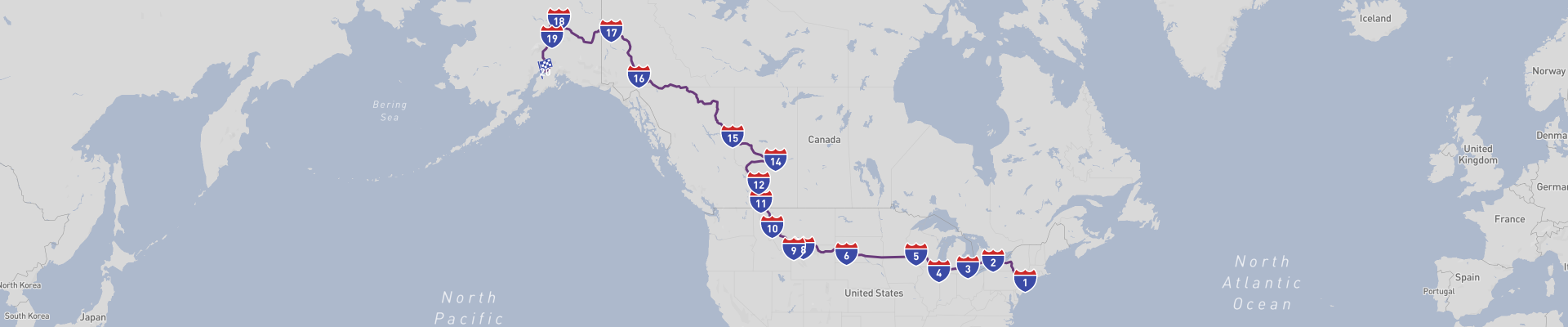
New York to Alaska Grandtour is an epic road trip of about 9315km from New York City to Anchorage, recommended to do in roughly 30 days so you’re not just racing the odometer. The best time of year to drive is late May to early September, when most mountain passes are open, days are long and you’re less likely to hit serious snow or ice. You start in New York City, where you can warm up with some classic sightseeing: stroll through Central Park, visit the Statue of Liberty and Ellis Island (part of the UNESCO-listed “Statue of Liberty” site), walk the High Line, or hit a museum like the Met or MoMA before you point the car west and leave the East Coast skyline behind.
Heading northwest through New York State, the landscape gradually softens into rolling hills, vineyards and lakes until you reach Niagara Falls. The town itself is built around the falls, and yes, they really are worth the hype. The American Falls and Bridal Veil Falls sit on the U.S. side, with the Horseshoe Falls curving dramatically into Canada. You can take a boat tour into the mist, walk the paths along the rim, or explore the Cave of the Winds platforms right next to the roaring water. On the Canadian side (just across the bridge, if you decide to hop over), the view of the full curtain of falls is especially impressive. From here, the route bends further west toward the Midwest’s big hub: Chicago.
Chicago is a perfect urban stopover on this long haul, set on the shore of Lake Michigan. The city’s skyline is legendary, and an architecture boat tour on the Chicago River is a fun way to get the backstory on all those towers. Millennium Park with the famous “Bean” sculpture (Cloud Gate), the Art Institute of Chicago with its huge art collection, and Navy Pier with lake views are all easy to reach in a day or two. Food-wise, this is the place to dive into deep-dish pizza, hot dogs “Chicago style,” and a huge range of neighborhood restaurants. From Chicago, the drive heads out into big-sky country, with longer stretches between towns and the feeling that you’re really pushing into the interior of the continent.
As you move west, you eventually reach Badlands National Park in South Dakota, a highlight of the central part of the trip. The “town” stop here is essentially the park area and nearby small communities, but the real attraction is the landscape: eroded buttes, sharp ridges and layered rock formations that look almost alien, especially at sunrise and sunset. There are short hikes and scenic overlooks right off the main road, plus a good chance to see bison, bighorn sheep and prairie dogs. While not a UNESCO site, it’s one of those must-see American national parks, and a strong contrast to both the big cities you’ve passed and the mountains still ahead. Continuing west, the plains give way gradually to more rugged terrain as you head toward Wyoming and the town of Cody.
Cody, Wyoming, markets itself as a gateway to the Old West, and it feels like it: wide streets, western-style storefronts, and a strong rodeo and cowboy culture. The big attraction is the Buffalo Bill Center of the West, a cluster of museums under one roof that covers western art, natural history, firearms history and the legacy of Buffalo Bill Cody. In summer, there are often nightly rodeos where you can watch bull riding and barrel racing under the lights. Cody is also a popular jumping-off point for Yellowstone National Park, so you may want to add a side trip if your schedule allows. After Cody, the drive turns more mountainous and forested as you push into Montana and on toward Missoula.
Missoula, Montana, sits in a valley surrounded by mountains and rivers, and it has a laid-back, outdoorsy vibe with a university-town twist. The Clark Fork River runs right through town, where people surf a standing wave, kayak and float on warm days. Downtown is compact and walkable, with breweries, cafés and local shops. Nearby trails lead up into the hills for views over the valley, and you’re close to bigger wilderness areas if you want to hike or fish. This is a good spot to rest, resupply and enjoy small-city life before tackling the more remote northern stretches on the way to Alaska.
From Missoula to Anchorage, the road gets wilder and more remote, often following parts of the historic Alaska Highway and other long northern routes through British Columbia and the Yukon (if you choose the classic overland path). Expect long days behind the wheel, huge mountain views, glaciers in the distance, conifer forests that seem endless and frequent wildlife sightings—moose, bear, caribou and more along or even on the road. Once you cross into Alaska and finally roll into Anchorage, you’re back in a relatively sizeable city, ringed by mountains and close to the water. Anchorage offers plenty of urban comforts—restaurants, museums like the Anchorage Museum, and access to nearby natural spots like Chugach State Park and the coastal Turnagain Arm. It’s a good place to decompress, look back over what you’ve just driven and maybe plan side trips deeper into Alaska if you still have time and energy.
Road conditions on this grand tour vary a lot. The eastern and midwestern segments are mostly on well-maintained interstates and major highways, but traffic around big cities and heavy trucks on long stretches can be tiring. The further northwest you go, the more you’ll encounter narrower roads, construction zones, rough patches, and stretches with limited services. Weather is the biggest factor: even in late spring or early fall, mountain passes and northern highways can see sudden snow, heavy rain or fog. Wildlife on the road is a real risk in northern regions, especially at dawn and dusk, so you need to stay alert. Fuel and lodging can be far apart in some areas, so it’s smart to top off your tank regularly, carry basic emergency gear and check road and weather updates before you commit to longer remote sections. If you plan well and respect the distances and conditions, the New York to Alaska Grandtour rewards you with a huge cross-section of North America, from dense East Coast cities to high plains, badlands, cowboy country, mountain valleys and finally the wilds of the far north.
 30
number of days
30
number of days
 9,315 km
route length
9,315 km
route length
 high
budget
high
budget
 tourist
good for
tourist
good for
 on the right
traffic direction
on the right
traffic direction
 moderate
accident level
moderate
accident level
START
New York City
Distance 9,315 km
Driving time 108.0 h
Pace: fast
2,794.5 kWh
Airports
LGA
,
EWR
[detailsContainer]
New York City is an awesome kickoff point for the New York to Alaska Grandtour. It packs big-city energy, iconic sights, and plenty of spots to stretch your legs before heading out on the highway.
Must‑see highlights:
- Times Square – Neon lights, giant billboards, and nonstop street action. It’s touristy, but worth a quick walk, especially at night.
- Central Park – Perfect for a breather before your long drive. Walk, rent a bike, or just chill by Bethesda Terrace or the Great Lawn.
- Statue of Liberty & Ellis Island – Take a ferry from Battery Park for classic skyline views and a dose of history.
- Brooklyn Bridge – Walk it for killer views of Manhattan and Brooklyn. Great photo spot at sunrise or sunset.
- 9/11 Memorial & Museum – A powerful, quiet place right in Lower Manhattan; the outdoor memorial pools are free to visit.
- Top of the Rock or One World Observatory – Go up for panoramic city views before you swap skyscrapers for open road.
Closest international airport is
John F. Kennedy International Airport (JFK), about 15–20 miles from Midtown Manhattan depending on your route and traffic.
Car rentals are widely available at JFK. Major companies like Hertz, Avis, Enterprise, Budget, Alamo, National and others operate from a dedicated rental car center. You reach them via the free AirTrain from any terminal. It’s worth booking your car in advance, especially if you want a specific type of vehicle for a long road trip.
1
New York City
- Niagara Falls
Distance 657 km
Driving time 6.9 h
Pace: fast
197.2 kWh
↓
View map
↓
Itinerary
[detailsContainer]
Starting in New York City, you’ll roll out from a skyline of steel and glass and dive straight into a drive packed with character. Over about 657 km and fewer than 7 hours behind the wheel, you’ll trade skyscrapers for wide‑open views and ever greener scenery as you head toward Niagara Falls.
Leaving New York City, take a little time to wander its streets before you go: the energy, the history in its buildings, and the way the city shifts from block to block are worth a slow walk before a long drive. Once you’re on the road, keep an eye out for historical sites peeking through modern towns and for those stretches where the highway opens onto surprisingly picturesque landscapes. Some UNESCO Heritage sites are along the route, adding an extra layer of meaning when you pull over and step out of the car.
Your destination, Niagara Falls, rewards the drive with raw power and constant mist in the air. Park the car, walk the viewpoints, and take your time to watch the water from different angles, especially around sunset.
More info on attractions, accommodation options, recommended restaurants, and campsites along the route is available in the Itinerary of this stage.
 Niagara Falls - United States - North America - Road Trip - commons.wikimedia.org
❯
❮
2
Niagara Falls
- Detroit
Distance 383 km
Driving time 4.1 h
Pace: fast
115.0 kWh
↓
View map
↓
Itinerary
[detailsContainer]
Kicking off in Niagara Falls, United States, this 383 km hop to Detroit packs a lot into fewer than 5 hours behind the wheel.
Before you roll out, take a last look at the roaring Niagara Falls themselves – the raw power of the water never really gets old, especially at sunrise. Once on the road, you’ll want to keep an eye out for stretches where the landscape opens up into gentle farmland and riverside views; this is where the drive becomes more than just getting from A to B. Along the way, some UNESCO Heritage sites are along the route, so history lovers should stay alert for signs and short detours that lead to old industrial landmarks and preserved districts with serious story value.
Rolling into Detroit, dive straight into its reborn downtown and riverfront. The city’s historic architecture, legendary music roots, and bold street art give you plenty to explore on foot after parking up. The mix of restored buildings and modern projects makes every block feel like a living museum, perfect for an afternoon wander before finding a spot to crash for the night.
More info about attractions, accommodation options, recommended restaurants, and campsites along the route is available in the "Itinerary" of this stage.
Detroit - United States - North America - Road Trip - Wikimedia Commons
❯
❮
3
Detroit
- Chicago
Distance 455 km
Driving time 4.5 h
Pace: fast
136.5 kWh
↓
View map
↓
Itinerary
[detailsContainer]
Rolling out of Detroit and cruising the 455 km to Chicago in under 5 hours is the kind of drive that begs for a bit of exploring before you hit the interstate again.
In Detroit, take time to wander through the Detroit Institute of Arts, where the famous murals and huge collection of American and European art are perfect for a slow start to the day. If you’re into music history, the Motown Museum is a must-stop: it’s compact, full of stories, and you’ll feel the city’s soul before you even get back behind the wheel.
As you head toward Chicago, keep an eye out for historical sites and those stretches of road where the landscape opens up into classic Midwestern scenery. This is where it pays to ease off the gas a little and just enjoy the drive.
Rolling into Chicago, park up and stretch your legs around Millennium Park, then wander over to the Art Institute of Chicago to dive into another world-class collection, from Impressionist masters to modern icons.
For more info on attractions, accommodation options, recommended restaurants, and campsites along this route, check the "Itinerary" of this stage.
Chicago - United States - North America - Road Trip - www.goodfreephotos.com
❯
❮
4
Chicago
- La Crosse
Distance 455 km
Driving time 4.6 h
Pace: fast
136.6 kWh
↓
View map
↓
Itinerary
[detailsContainer]
Rolling out of Chicago and heading toward La Crosse, you’ve got about 455 km and under 5 hours of open road ahead, with plenty worth slowing down for along the way.
Before you leave Chicago, squeeze in a stroll around Millennium Park to catch the city’s modern vibe and skyline views, then swing by the Art Institute of Chicago for a quick hit of world‑class art and a sense of the city’s cultural roots. If you’re into history and architecture, a look at the Chicago Riverwalk gives you a great perspective on the city’s storied buildings before you hit the highway.
As you push northwest, keep an eye out for changing scenery as the flatlands give way to more rolling, picturesque landscapes. Closing in on La Crosse, the route starts to flirt with bluff country and river views that are perfect for short scenic pull‑offs and photos.
In La Crosse, head straight for Grandad Bluff for sweeping views over the Mississippi River and the town below, a classic reward after a few hours behind the wheel.
More details on attractions, accommodation, recommended restaurants, and campsites along this stage are available in the Itinerary of this route.
La Crosse - United States - North America - Road Trip - commons.wikimedia.org
❯
❮
5
La Crosse
- Badlands N.P.
Distance 950 km
Driving time 8.9 h
Pace: fast
285.1 kWh
↓
View map
↓
Itinerary
[detailsContainer]
Leaving La Crosse, you roll out along the Mississippi River, trading city streets for open views and big‑sky vibes on a scenic road that makes the 950 km feel way shorter than the under‑9‑hour drive suggests.
At the start, take a little time to enjoy La Crosse itself: wander down to the riverfront for classic river views and, if you’re around early, catch the soft morning light on the water before you hit the highway. It’s a relaxed spot that eases you into road‑trip mode: coffee in hand, tank full, playlist ready.
As you push west and the landscape slowly opens up, keep an eye on the horizon; the approach to Badlands National Park is where the drive really pays off. Out of nowhere, those jagged rock formations and striped cliffs rise from the prairie, and the road starts to twist through otherworldly scenery. When you reach Badlands N.P., stop at several overlooks, walk a short trail if you have time, and stick around for sunset—colors here go wild in the late light.
More info about attractions, accommodation options, recommended restaurants, and campsites along the route is available in the "Itinerary" of this stage.
Badlands N.P. - United States - North America - Road Trip - www.goodfreephotos.com
❯
❮
6
Badlands N.P.
- Rapid City
Distance 103 km
Driving time 1.1 h
Pace: fast
30.8 kWh
↓
View map
↓
Itinerary
[detailsContainer]
Leaving Badlands National Park and heading toward Rapid City, you’ve got about 103 km of easy driving ahead of you, under 1 hour on the road, but don’t rush it.
Before rolling out of Badlands National Park, take time to cruise the park roads slowly and pull over at a few overlooks. The layered rock formations and open prairie make this stretch feel like you’re driving through another planet, and the viewpoints are perfect for quick photo and leg-stretch stops. Keep an eye out for historic information panels along the way; they add a lot of context to what you’re seeing out the window.
As you close in on Rapid City, the scenery softens and you’ll notice how the landscape shifts from rugged badlands to rolling hills and a more urban vibe. Once you reach Rapid City, park up and wander the downtown streets on foot. The city’s historic buildings and street art make it a fun place to explore after a day behind the wheel, and it’s an easy base for planning your next drives.
More info on attractions, accommodation, recommended restaurants, and campsites along this route is available in the "Itinerary" of this stage.
Rapid City - United States - North America - Road Trip
Rapid City - United States - North America - Road Trip - www.ellsworth.af.mil
❯
❮
7
Rapid City
- Cody
Distance 628 km
Driving time 6.6 h
Pace: fast
188.5 kWh
↓
View map
↓
Itinerary
[detailsContainer]
Rolling out of Rapid City and pointing your wheels toward Cody, you’ve got about 628 km ahead and fewer than 7 hours of pure road-trip freedom. Before you hit the highway, wander downtown Rapid City, where street art, local shops, and laid‑back bars set an easygoing vibe and give you a last city fix before the wide‑open West takes over.
Once you’re on the move, keep an eye out for historical markers and those sweeping, picture‑perfect landscapes that pop up around every bend. This stretch is all about watching the scenery slowly shift, with rugged horizons, big skies, and the kind of long, scenic road that makes you want to pull over just to soak it all in. It’s the sort of drive where you crack the windows, turn up the music, and let the miles roll by.
Rolling into Cody, the town welcomes you with a frontier feel that’s made for travelers. It’s a great place to stretch your legs, grab a hearty meal, and dive into the local Western character before you carry on.
More info on attractions, accommodation options, recommended restaurants, and campsites along this stage is available in the Itinerary of this stage.
Cody - United States - North America - Road Trip - commons.wikimedia.org
❯
❮
8
Cody
- Yellowstone N.P.
Distance 156 km
Driving time 2.7 h
Pace: modest
40.6 kWh
↓
View map
↓
Itinerary
[detailsContainer]
Leaving Cody, you roll out of a town that still feels like the Old West. Before hitting the road, wander around Cody itself: check out its historic core and soak up the cowboy vibe that makes this place such a fun launchpad. Once you’re driving, the route to Yellowstone N.P. (about 156 km, under 3 hours) quickly turns into a scenic ride, with rock walls, river views, and wide-open Wyoming skies.
Stay alert for historical sites right along the road, where the landscape tells stories of early travelers and frontier days. The drive is gorgeous but not always easygoing: some sections of the route may be closed seasonally, there will be steep ramps, in some sections the road is very winding, and in sections the road will be narrow, so take your time and enjoy the views.
Rolling into Yellowstone N.P., the scenery shifts to forests, rivers, and steaming geothermal areas that make this park legendary. It’s the kind of place where you’ll want to park often, walk a bit, and just stare. This drive is a highlight for any road-tripper.
More info on attractions, accommodation options, recommended restaurants, and campsites along the route is available in the "Itinerary" of this stage.
Yellowstone N.P. - United States - North America - Road Trip - Good Free Photos
Yellowstone N.P. - United States - North America - Road Trip - National Park Service
Yellowstone N.P. - United States - North America - Road Trip - commons.wikimedia.org
❯
❮
9
Yellowstone N.P.
- Missoula
Distance 505 km
Driving time 6.7 h
Pace: fast
151.5 kWh
↓
View map
↓
Itinerary
[detailsContainer]
Rolling out of Yellowstone National Park, you’re leaving behind geysers, bison-dotted valleys, and steaming hot springs, but the drive to Missoula keeps the wow-factor high. Over about 505 km and fewer than 7 hours behind the wheel, you’ll trace rivers, climb forested slopes, and cruise through big-sky country that feels made for a road trip. Some sections of the route may be closed seasonally, so it’s worth checking conditions before you go.
Outside Yellowstone, keep an eye out for old bridges, ranch buildings, and small-town main streets that hint at the region’s frontier past; this is a run where you’ll want to slow down for historical sites and soak up the atmosphere rather than just blast through. In some sections the road is very winding, hugging hillsides and riverbanks, and in sections the road will be narrow, so take it easy, enjoy the views, and give yourself time for photo stops along these scenic stretches.
Rolling into Missoula, you’ll find a lively mountain town with riverfront hangouts and a relaxed, outdoorsy vibe that’s perfect after a long drive. More information regarding attractions, accommodation options, recommended restaurants, and campsites along the route is available in the "Itinerary" of this stage.
Missoula - United States - North America - Road Trip - Wikimedia Commons
❯
❮
10
Missoula
- Cranbrook
Distance 415 km
Driving time 4.7 h
Pace: fast
124.5 kWh
↓
View map
↓
Itinerary
[detailsContainer]
Leaving Missoula, you roll out on a 415 km stretch that takes fewer than 5 hours, but you’ll want to slow down and soak it in.
In Missoula, wander through the historic downtown and pay attention to the old brick buildings and railway heritage as you stroll. It’s worth taking a walk by the river before you hit the road, with those classic mountain views setting the mood for the drive.
As you head north, the scenery shifts between wide valleys and forested hillsides, with plenty of moments where the road suddenly opens to picturesque landscapes. Along the way, keep an eye out for viewpoints where you can safely pull over for photos of the surrounding peaks and rivers. Some sections of the route may be closed seasonally, so it’s smart to check conditions before you go, especially in the shoulder seasons.
Rolling into Cranbrook, the vibe changes from pure road mode to small-city history. Make time for the historic downtown streets and old buildings that tell the story of this railway town. The setting in the surrounding mountains gives you a scenic backdrop pretty much everywhere you look.
More information regarding attractions, accommodation options, recommended restaurants, and campsites along the route is available in the "Itinerary" of this stage.
Cranbrook - United States - North America - Road Trip - Wikipedia
Cranbrook - United States - North America - Road Trip - Kootenay Rockies Tourism
❯
❮
11
Cranbrook
- Banff N.P.
Distance 268 km
Driving time 3.4 h
Pace: fast
80.5 kWh
↓
View map
↓
Itinerary
[detailsContainer]
Starting in Cranbrook, you’ll roll out into a relaxed small-city vibe that’s perfect for stocking up and stretching your legs before hitting the road. Wander the compact downtown and check out the local museums and heritage buildings; they’re a great warm-up for the historic feel of this drive. As you head out, keep an eye on the surrounding mountains and valleys – the road quickly turns into a string of picturesque landscapes that make the 268 km feel way shorter than the under-4-hour drive time suggests.
As you get closer to Banff National Park, the scenery ramps up dramatically. The highway becomes a classic scenic road, with towering peaks and sweeping views that will have you pulling over at viewpoints whenever you can. Once inside Banff National Park, take time to explore its mountain trails, lakes, and viewpoints; even short walks can deliver serious wow-factor. Remember that some sections of the route may be closed seasonally, so it’s worth checking current conditions before you set off.
For more info on attractions, accommodation options, recommended restaurants, and campsites along the route, have a look at the "Itinerary" of this stage.
Banff N.P. - United States - North America - Road Trip - Wikimedia Commons
Banff N.P. - United States - North America - Road Trip - Wikipedia
❯
❮
12
Banff N.P.
- Jasper N.P.
Distance 233 km
Driving time 3.3 h
Pace: fast
70.0 kWh
↓
View map
↓
Itinerary
[detailsContainer]
Leaving Banff National Park and heading toward Jasper National Park, you’ve got about 233 km of driving and fewer than 4 hours behind the wheel, but it’s the kind of route you’ll want to stretch out as much as possible.
Right from Banff, the mountains close in and the views are non‑stop, so keep your eyes peeled for those classic rugged peaks and turquoise valleys. This is a road where the scenery is the main event, so plan plenty of stops to soak it all in instead of rushing. Some sections of the route may be closed seasonally, so it’s worth checking conditions before you roll out, especially if you’re traveling early or late in the season.
As you cruise toward Jasper National Park, the landscapes get wilder and more dramatic, with pristine forests, towering cliffs, and sweeping valleys unfolding around every curve. You’ll be driving through an area so special that some UNESCO Heritage sites are along the route, which really adds to the sense that you’re passing through something rare and protected.
More information regarding attractions, accommodation options, recommended restaurants, and campsites along the route is available in the "Itinerary" of this stage.
Jasper N.P. - United States - North America - Road Trip - commons.wikimedia.org
❯
❮
13
Jasper N.P.
- Edmonton
Distance 374 km
Driving time 3.9 h
Pace: fast
112.3 kWh
↓
View map
↓
Itinerary
[detailsContainer]
Rolling out of Jasper National Park and heading toward Edmonton, you’ve got about 374 km of open road ahead and fewer than 4 hours of driving, so there’s plenty of time to enjoy the ride without rushing.
In Jasper National Park, make sure you soak up the mountain views, turquoise rivers, and those classic Canadian forests that seem to go on forever. Keep your eyes peeled for wildlife and stop at scenic pullouts whenever you can. Some UNESCO Heritage sites are along the route, so it’s worth taking a few extra minutes at viewpoints and trailheads to read signs and get a feel for the area’s history and geology.
As you get closer to Edmonton, the landscape slowly shifts from rugged peaks to rolling fields and big-sky prairie, which is a pretty cool contrast in just one drive. When you arrive in Edmonton, take time to explore the river valley and downtown streets, where old buildings and bridges hint at the city’s past, all mixed in with a laid-back urban vibe that’s great after a day on the road.
More info on attractions, accommodation options, recommended restaurants, and campsites along this route is available in the bItineraryb of this stage.
Edmonton - United States - North America - Road Trip - City of Edmonton
❯
❮
14
Edmonton
- Dawson Creek
Distance 593 km
Driving time 6.0 h
Pace: fast
177.9 kWh
↓
View map
↓
Itinerary
[detailsContainer]
Leaving Edmonton and cruising the 593 km north toward Dawson Creek (in fewer than 6 hours of driving) makes for an easy, rewarding stretch. Start your day in Edmonton with a walk around its riverside districts and a quick look at its historic buildings before you hit the highway; it sets a nice tone for the rest of the drive.
Once you’re out of the city, keep an eye out for historical sites along the way and enjoy the long views of fields and forest that slowly give way to more rugged, rolling country. The road treats you to plenty of picturesque landscapes, and there are stretches where the scenery really shines, so it’s worth planning a few photo stops rather than rushing straight through.
As you approach Dawson Creek, the feel changes again, with a classic small‑town vibe and a strong sense of northern history. The town is a great place to stretch your legs, wander around its historic spots, and soak up the atmosphere before moving on. Some sections of the route may be closed seasonally, so it’s smart to check conditions in advance. More info on attractions, accommodation options, recommended restaurants, and campsites along the route is available in the "Itinerary" of this stage.
Dawson Creek - United States - North America - Road Trip - Wikipedia
❯
❮
15
Dawson Creek
- Whitehorse
Distance 1,403 km
Driving time 17.2 h
Pace: fast
421.0 kWh
↓
View map
↓
Itinerary
[detailsContainer]
Starting in Dawson Creek, you roll right into the spirit of the Alaska Highway at Mile 0. Before hitting the gas, take a little time to wander around the historic Mile 0 Post and nearby markers, where you can soak up stories about how this legendary route was carved through the wilderness. Road-trippers who love old-school vibes and big sky views will really feel the pull of the open road here.
From Dawson Creek to Whitehorse it’s about 1403 km, with fewer than 18 hours of pure driving, but you’ll want to slow down. As you head northwest, the road rewards you with long stretches of scenic highway, rolling hills, and huge, open valleys. Keep your eyes peeled for picturesque landscapes that shift with every bend, and make regular stops to enjoy the viewpoints and historical roadside pullouts that highlight the area’s past.
Some sections of the route may be closed seasonally, so it’s worth checking conditions before you set off, especially outside the summer months.
You’ll eventually roll into Whitehorse, where the river, the surrounding mountains, and the town’s frontier history create an awesome payoff at the end of this stage.
More information regarding attractions, accommodation options, recommended restaurants, and campsites along the route is available in the Itinerary of this stage.
Whitehorse - United States - North America - Road Trip - Wikimedia Commons
Whitehorse - United States - North America - Road Trip - Wikimedia Commons
❯
❮
16
Whitehorse
- Dawson City
Distance 532 km
Driving time 7.0 h
Pace: fast
159.6 kWh
↓
View map
↓
Itinerary
[detailsContainer]
Leaving Whitehorse and rolling north toward Dawson City, you’ve got about 532 km of open road ahead and fewer than 7 hours of driving, not counting your photo and snack stops.
Before you hit the highway, wander around Whitehorse a bit: walk the waterfront, check out the local vibe, and soak up the frontier feel that still hangs over town. Once you’re on the move, pay attention to the historical sites popping up along the way and the seriously picturesque landscapes that keep changing with every bend. This stretch is all about a scenic road that makes you want to pull over just to stare for a while.
Some sections of the route may be closed seasonally, so it’s worth checking conditions before you set off. As you get closer to Dawson City, the history really kicks in: the gold rush past is everywhere, from old buildings to the atmosphere in town, and it’s easy to imagine the chaos of the Klondike days while you stroll the streets after your drive.
More info about attractions, accommodation options, recommended restaurants, and campsites along the route is available in the "Itinerary" of this stage.
Dawson City - United States - North America - Road Trip - commons.wikimedia.org
❯
❮
17
Dawson City
- Fairbanks
Distance 625 km
Driving time 9.3 h
Pace: fast
187.4 kWh
↓
View map
↓
Itinerary
[detailsContainer]
Rolling out of Dawson City and heading toward Fairbanks, you’ve got about 625 km of northern wilderness ahead of you, with fewer than 10 hours behind the wheel if you drive it in one go. Take your time, though—this stretch is all about soaking up history and big open scenery. Before leaving Dawson City, wander its historic streets, old gold rush buildings, and riverside views; it’s the perfect place to fuel up, grab supplies, and sink into that frontier vibe before you hit the road.
On the way toward Fairbanks, keep your eyes peeled for viewpoints and traces of the region’s past whenever you stop—this drive rewards those who pull over often, stretch their legs, and explore short side strolls to overlooks or historic markers. Some sections of the route may be closed seasonally, so it’s worth checking conditions before you roll out and being flexible with your timing.
Rolling into Fairbanks, you swap wild highway views for a laid-back city with a strong northern character, where you can dive into local history, enjoy the riverfront atmosphere, and use it as a comfortable base to rest up before the next driving day.
For more info on attractions, accommodation options, recommended restaurants, and campsites along the route, check the Itinerary of this stage.
Fairbanks - United States - North America - Road Trip - Wikimedia Commons
❯
❮
18
Fairbanks
- Denali N.P.
Distance 206 km
Driving time 2.5 h
Pace: fast
61.8 kWh
↓
View map
↓
Itinerary
[detailsContainer]
Leaving Fairbanks, you roll out of town and quickly swap city streets for Alaska’s wide‑open feeling. Before you go, it’s worth wandering through Fairbanks itself: check out the riverside areas and local museums that dig into Gold Rush history and Native Alaskan culture, perfect for setting the mood before you hit the road.
The drive to Denali National Park is about 206 km and usually takes fewer than 3 hours, but you’ll want extra time for views and photo stops. Some sections of the route may be closed seasonally, so it’s smart to check conditions in advance. As you head south, keep an eye out for historical sites tied to early pioneers and the development of interior Alaska, as well as long, scenic stretches where the road seems to float over endless forest and tundra.
You’ll encounter a few steep ramps and, in some sections, the road is very winding, so take it easy and enjoy the scenery. Approaching Denali National Park, the landscape suddenly feels bigger, wilder, and more dramatic, with mountains pulling you forward toward the park entrance.
More info on attractions, accommodation options, recommended restaurants, and campsites along the route is available in the "Itinerary" of this stage.
Denali N.P. - United States - North America - Road Trip - www.nps.gov
❯
❮
19
Denali N.P.
- Anchorage
Distance 371 km
Driving time 4.6 h
Pace: fast
111.4 kWh
↓
View map
↓
Itinerary
[detailsContainer]
Leave the wild beauty of Denali National Park behind and roll south toward Anchorage, a stretch of about 371 km that takes fewer than 5 hours of driving. Before you hit the road, give yourself time to soak up Denali’s hiking trails and viewpoints, where the mountain dominates the skyline and wildlife often steals the show. Once you’re driving, keep an eye out for historical sites and lookouts along the way; this route rewards curious stops with big views and great photo spots.
The road serves up seriously picturesque landscapes, with broad river valleys, forested hills, and mountain backdrops that keep changing around each bend. Some sections of the route may be closed seasonally, so it’s worth checking conditions before you go. There will be steep ramps and in some sections the road is very winding, so take it easy, especially in bad weather or if you’re driving a larger rig.
Rolling into Anchorage, treat it as your urban base camp, with coastal scenery, museums, and a lively food scene waiting once you park the car. More information regarding attractions, accommodation options, recommended restaurants, and campsites along the route is available in the "Itinerary" of this stage.
Anchorage - United States - North America - Road Trip - Pixabay
❯
❮
Anchorage
[detailsContainer]
Anchorage is an awesome finale for your New York to Alaska Grandtour, mixing real wilderness vibes with city comforts right at the edge of the mountains and the ocean.
Rolling into town by car, you’ll notice how spread out everything is, so keep your vehicle handy. Downtown Anchorage is a good base: easy parking, food options, and quick access to the Coastal Trail. The Tony Knowles Coastal Trail is a must-do for roadtrippers who need to stretch their legs after long miles: walk, bike, or rent an e-scooter and soak up killer views of Cook Inlet and, on clear days, distant volcanoes.
Head to Earthquake Park to see where the 1964 quake reshaped the land, and then drive up to Flattop Mountain trailhead in the Chugach Mountains. Even if you don’t hike all the way, the viewpoint offers one of the best overlooks of Anchorage and the inlet, especially at sunset. For wildlife and local culture, hit the Alaska Native Heritage Center and the Alaska Wildlife Conservation Center (about an hour south on the Seward Highway), both super roadtrip-friendly with big parking areas and easy access.
If you’re into scenic drives, don’t miss Turnagain Arm on the Seward Highway. It’s one of the most dramatic stretches of pavement in the state: mountains dropping straight into the water, frequent beluga whale sightings in season, and pullouts almost every few miles for photos.
Flying in or out? The closest international airport is Ted Stevens Anchorage International Airport (IATA: ANC), about a 10–15 minute drive from downtown, with plenty of rental car options for continuing your road adventure.
As an ending point for the New York to Alaska Grandtour, Anchorage gives you that satisfying “we made it” feeling, with enough trails, viewpoints, and day trips to easily fill a few recovery days before you turn around or fly home.
New York to Alaska Grandtour Road Trip at a glance
-
Start:
New York City
-
End:
Anchorage
-
Distance:
9,315 km
-
Stay:
30 days
-
Getting there:
La Guardia Airport (LGA),
Newark Liberty International Airport (EWR)
-
When to drive:
June, July, August, September
-
More info:
More info you can find in the "Itinerary" section at each stage.

 -
-